How to Write a Change Impact Assessment in Under an Hour (With AI)
If you're a Business Change Manager, you already know the drill: a Change Impact Assessment (CIA) that should take an hour ends up eating a full day. Workshop notes to sort through. A blank template staring back at you. Severity ratings to justify. And somewhere in there, an executive summary that needs to land with senior stakeholders who don't have time for detail.
Rochelle
6/28/20262 min read
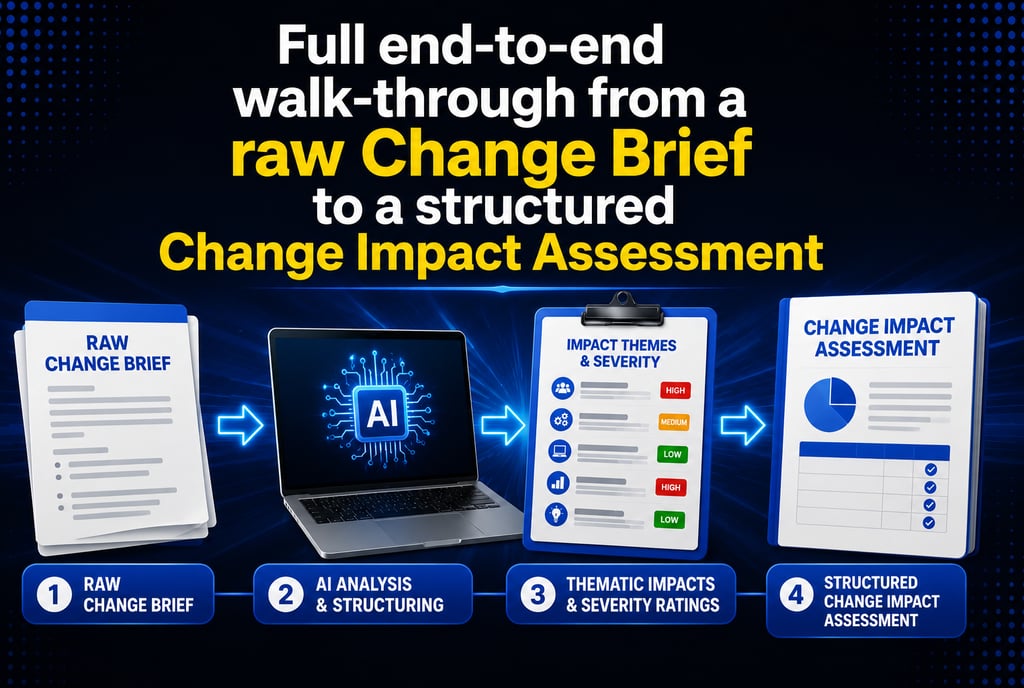
Here's the thing, AI doesn't replace any of the judgement that makes a CIA useful. It removes the time you spend on the parts that aren't judgement at all: structuring, summarising, and formatting.
I tested this on a real scenario rolling out a new HR system, Luminary HR, to 800 employees using Microsoft Copilot and my own READ Prompt Model (Role, End Goal, Audience, Details). Here's what that process actually looks like.
Start with the brief, not the blank page
Most CIAs stall because you're starting from nothing. Instead, feed your change brief and workshop notes into Copilot using the READ structure:
Role: who you are (a Change Manager, in this context)
End Goal: what you need (a structured impact summary)
Audience: who it's for (your project team, then later, senior stakeholders)
Details: the actual content your brief, notes, scope
This turns scattered notes into a structured impact summary in minutes, not hours.
Build thematic impact tables with severity ratings
From that summary, the next step is organising impacts by theme people, process, technology, business each with a severity rating (High, Medium, Low). AI is genuinely strong at this part: pattern-spotting across messy workshop notes and pulling out what's actually high-impact versus what's noise.
This is also where most people stop too early. AI will draft severity ratings it won't validate them.
Validate everything against your context
This is the step that separates a useful CIA from a liability. AI-generated impact themes need to be checked against:
SME input — does the rated severity match what subject matter experts actually expect to see?
Organisational context does the AI output reflect your organisation's history, culture, and risk tolerance, or is it generic?
Speculative impacts AI tools will sometimes generate impacts that sound plausible but aren't grounded in your actual scope. Cut these.
Your professional judgement isn't optional here it's the entire point. AI gives you a fast first draft; you're still the one accountable for what goes in front of stakeholders.
Turn the draft into an executive summary
Once the impact table is validated, the same AI-assisted approach works for distilling it into an executive summary the version senior stakeholders actually read. Keep this step deliberately last: you want the summary built from validated impacts, not raw AI output.
Fit it into your own template
Don't try to make AI output replace your organisation's CIA template. Use it to populate your existing structure this keeps you compliant with whatever governance your organisation already has in place, and keeps the deliverable recognisable to the people reviewing it.
The result
What used to take a full day structuring notes, drafting themes, assigning severity, building an executive summar now takes under an hour, with the same (or better) quality, because AI does the structuring and you spend your time on the judgement calls that actually matter.
Want the prompts I used in this process?
I've put together a free Claude Prompt Library specifically for Business Change Managers including the exact prompts for impact assessments and stakeholder mapping referenced in this post. Every prompt uses the READ Prompt Model, and works across Claude, Copilot, and ChatGPT.
👉 Download the free Claude Prompt Library
Want to see this process in action? Watch the full walkthrough on YouTube: CIA in Under 1 Hour (AI-Powered)
Smart Tools for Smarter Business Change
Tools and insights for effective business transformation.
Email: info@techbiztoolkit.com
© 2026. All rights reserved.